Showing posts with label SINTAR. Show all posts

Saturday, 28 January 2023

Slaty-legged Crake a.k.a Banded Crake ( Sintar Merah)

Local name : Sintar Merah English name : Slaty-legged / Banded Crake Scientific name : Rallina eurizonoides 

Taman Botani Negara 20-02-2023

Taman Botani Negara 07-02-2023


The slaty-legged crake or banded crake (Rallina eurizonoides) is a waterbird in the rail and crake family, Rallidae.

Small, chickenlike dweller of dense forests and tangled edges. Dark brown above, with orange head and breast and black-and-white-striped sides. Juvenile similar but with brown head and breast, narrower white stripes below. Dark lead-gray legs distinguish this species from Red-legged Crake, Band-bellied, and Ruddy-breasted crakes, which also show different underpart patterns. 

Its breeding habitat is swamps and similar wet areas in well-wooded country across south Asia east from India, Pakistan, and Sri Lanka to the Philippines and Indonesia. The rails are mainly permanent residents throughout their range, but some northern populations migrate further south in winter.

Taman Botani Negara 05-02-2023


The slaty-legged crake is about 25 cm long. Its body is flattened laterally to allow easier passage through the undergrowth. It has long toes and a short tail. Colouring includes a brown back, chestnut head and breast, and strong black-and-white barring on the flanks, belly and undertail. The throat is white, the bill is yellowish, and the legs are green. Sexes are similar; juveniles are dark brown above and below, although they have the belly barring and white throat.


Slaty-legged crakes are territorial, but are quite secretive, hiding in bushes when disturbed. They probe with their bill in mud or shallow water, also picking up food by sight. They forage for berries and insects on the ground, or clambering through bushes and undergrowth. They nest in a dry location on the ground or low bush, laying 4–8 eggs. A study conducted in Nilambur, Kerala in southern India shows that the incubation period was about 20 days.


Taman Botani Negara 28-01-2023


Saturday, 21 May 2016

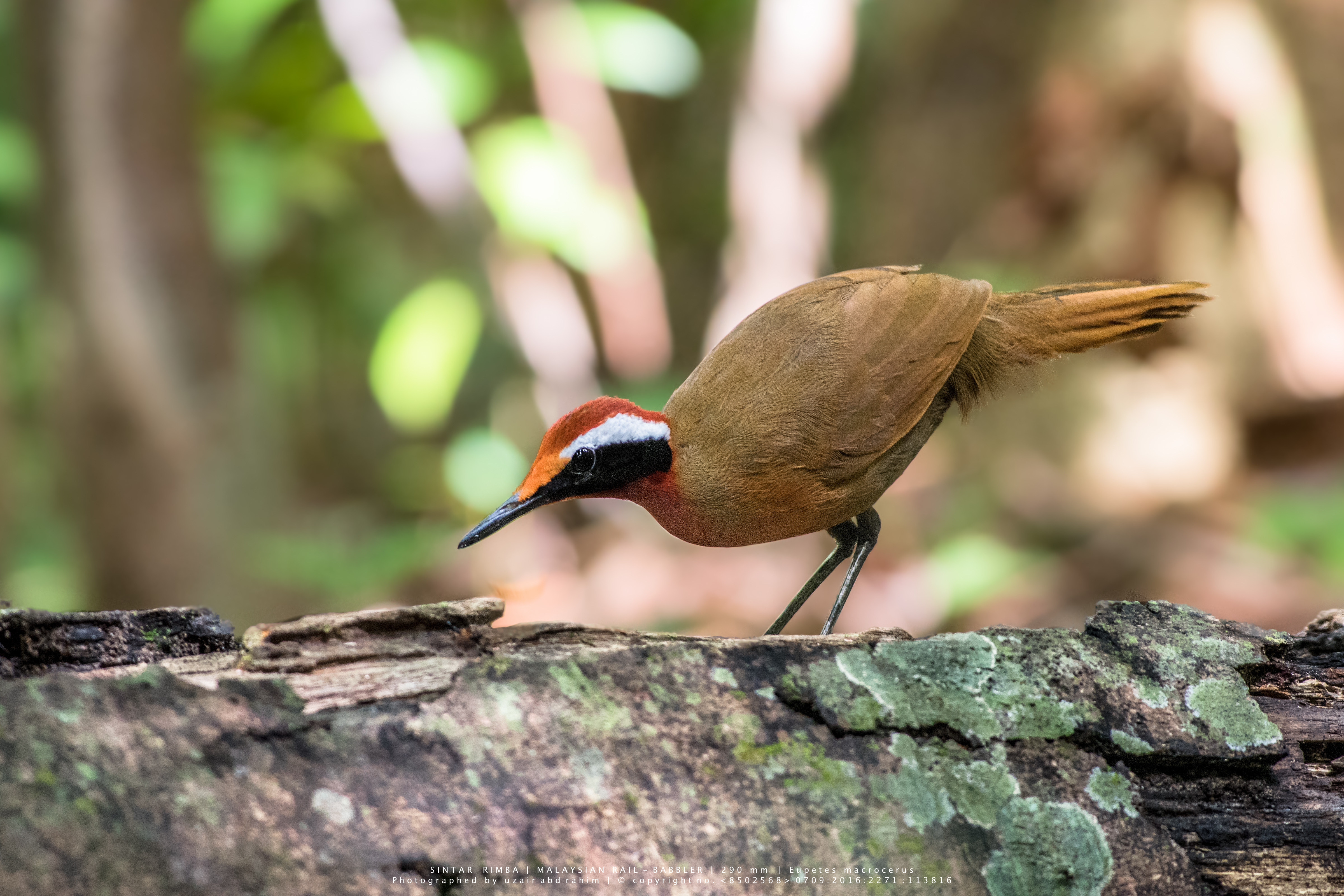
Sintar Rimba (Malaysian Rail-babbler)

Local name : Sintar Rimba  English name : Malaysia Rail-babbler  Scientific name : Eupetes macrocerus


The rail-babbler or Malaysian rail-babbler (Eupetes macrocerus) or Sintar Rimba is a strange, rail-like, brown and pied inhabitant of the floor of primary forest in the Malay Peninsular and Sumatra (the nominate subspecies macrocerus), as well as Borneo (ssp. borneensis), distantly related to African crow-like birds. Its population has greatly decreased because much of the lowland primary forest has been cut, and secondary forests usually have too dense a bottom vegetation or do not offer enough shade to be favourable for the species. However, it is locally still common in logged forest or on hill-forest on slopes, and probably not in immediate danger of extinction. The species is poorly known and rarely seen, in no small part due to its shyness.


Opinions on the correct taxonomic placement for the rail-babbler have differed. At one time, it was placed in the Old World babbler family, Timaliidae. Until recently, it had been regarded as being related to a group which included the quail-thrushes and whipbirds, and placed in the family Cinclosomatidae (previously in Orthonychidae when the members of the Cinclosomatidae were regarded as belonging with the logrunners).


However, Serle (1952) had pointed out a number of similarities between this species and the two species of rockfowl (Picathartes): similar proportions, the position of the nostrils, the shape of the forehead, and that of the tail.

Based on molecular studies, Jønsson et al. (2007) argues that this is closer to the correct position for this species; the rail-babbler is most closely related to the rockjumpers, another early branch of the oscine passerines. As such, it is more correctly placed in a monotypic family, Eupetidae.This is one of only three bird families restricted to the Oriental zoogeographical region.


It is a medium-sized, fairly slender songbird, about 28 to 30 cm (11–12 in) in length, and weighing 66 to 72 g (2.3–2.5 oz). It has a long thin neck, long black bill, long legs and a long tail. The plumage is mainly brown with a more reddish forehead, crown and throat. It has a long, black eyestripe extending from the bill to the side of the neck and a broad, white supercilium above it. There is a strip of bare, blue skin on the side of the neck which can be seen when the bird calls. Juvenile birds are similar to the adult but have duller head stripes, a whitish throat and greyer belly.


It has a long, monotonous whistling call. When agitated, it gives a series of frog-like notes.It is found on the Malay Peninsula in southern Thailand and Peninsular Malaysia and in the Greater Sundas on Sumatra, Borneo and the Natuna Islands. It mainly occurs in tall, lowland forests and also in swamps and heath forest. It sometimes occurs in lower montane forests up to about 1,060 m (3,480 ft) in Peninsular Malaysia and 900 m (3,000 ft) in Sumatra and Borneo. It is believed to be declining due to loss and degradation of the forest and is classed as near threatened.

It is a shy and secretive bird, which lives on the forest floor. It walks like a rail, jerking its head in the manner of a chicken, and it prefers to run rather than fly when disturbed. It feeds mainly on insects, including cicadas, and beetles; spiders and worms. When feeding it will dash after prey items.


Little is known about its breeding habits. The eggs are laid around January and February and fledgeling have been seen in June. The nest has been described as being placed near the ground on a pile of dead leaves among the stalks of a plant around 30 cm (12 in) from the ground. It is made of plant fibres and is a cup shape. The clutch is two white unmarked eggs, nothing else is known.