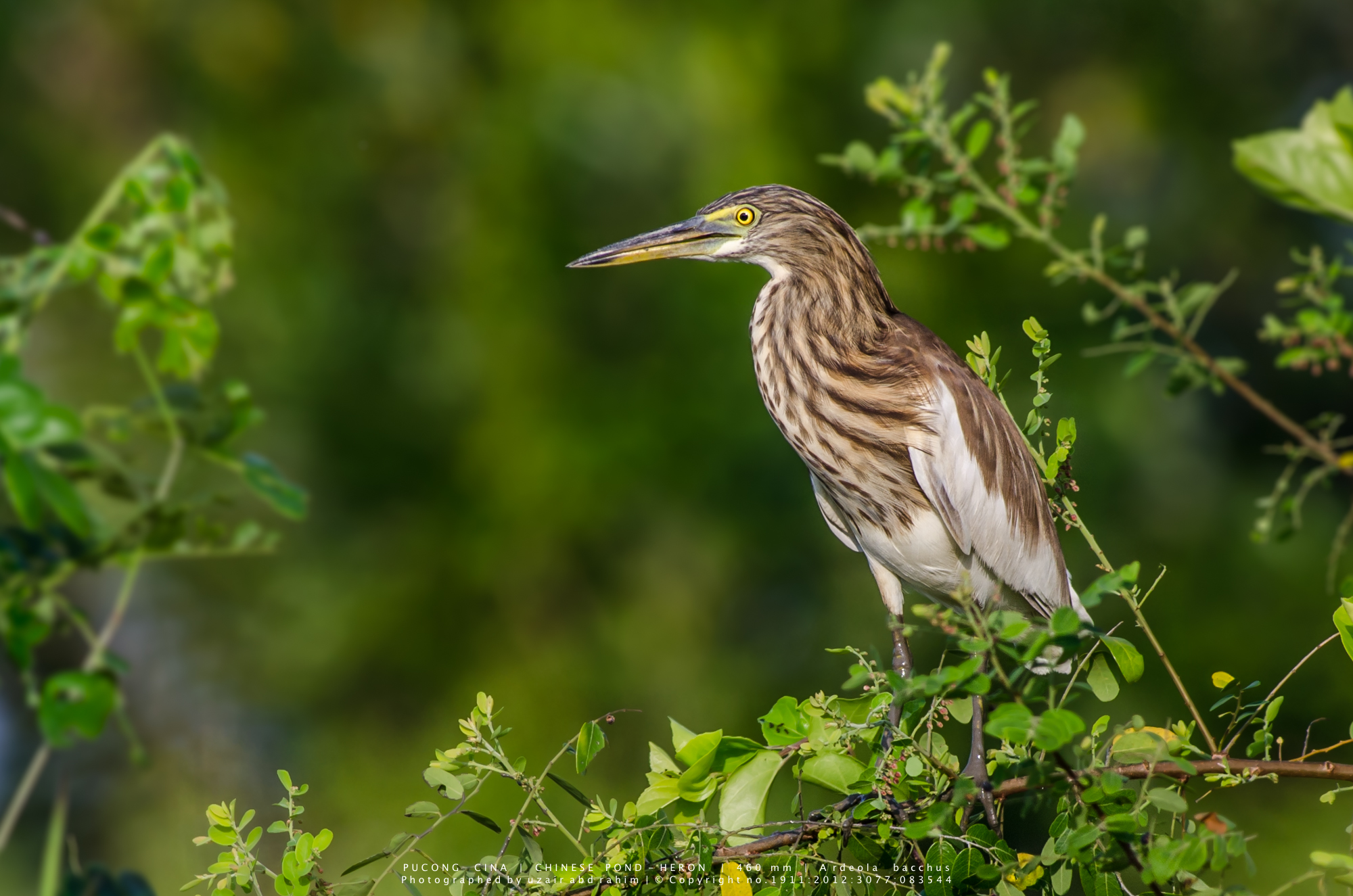
The Purple Heron (Ardea purpurea) is a wading bird in theheron family Ardeidae, breeding in Africa, central and southernEurope, and southern and eastern Asia. The European populations are migratory, wintering in tropical Africa; the more northerly Asian populations also migrate further south within Asia. It is a rare but regular wanderer north of its breeding range.
The Purple Heron is a large bird, 78–97 cm (31–38 in) in length with a standing height from to 70 to 94 cm (28 to 37 in) and a 120–152 cm (47–60 in) wingspan. However, it is slender for its size, weighing only 0.5–1.35 kg (1.1–3.0 lb). It is somewhat smaller than the Grey Heron, from which it can be distinguished by its darker reddish-brown plumage, and, in adults, darker grey back. It has a narrower yellow bill, which is brighter in breeding adults. The most similarly-colored heron is the Goliath Heron, which is considerably larger.
The Grey Heron (Ardea cinerea), is a wading bird of the heronfamily Ardeidae, native throughout temperate Europe and Asiaand also parts of Africa. It is resident in the milder south and west, but many birds retreat in winter from the ice in colder regions. It has become common in summer even inside the Arctic circle along the Norwegian coast.
It is a large bird, standing up to 100 cm (39 in) tall and measuring 84–102 cm (33–40 in) long with a 155–195 cm (61–77 in) wingspan. The body weight can range from 1.02–2.08 kg (2.2–4.6 lb). Its plumage is largely grey above, and off-white below. Adults have a white head with a broad blacksupercilium and slender crest, while immatures have a dull grey head. It has a powerful, pinkish-yellow bill, which is brighter in breeding adults. It has a slow flight, with its long neck retracted (S-shaped). This is characteristic of herons and bitterns, and distinguishes them from storks, cranes and spoonbills, which extend their necks. The call is a loud croaking "fraaank". The Australian White-faced Heron is often incorrectly called a Grey Heron. In Ireland the Grey Heron is often colloquially called a "crane".